
a new sun — how to prepare for the singularity
what to build inside yourself before the old world collapses.


there is a particular kind of morning that only occurs in early spring. the frost hasn’t fully left. the air still bites. but somewhere beyond the treeline the light is shifting, turning from grey to gold, and every bird in the valley knows it before you do. they’ve already changed their song.
the singularity is not a date on a calendar. it is a season approaching. you can feel it in the way conversations are changing, the speed at which the impossible becomes the mundane, the quiet panic of institutions that were built for a world that is already leaving. and the question that matters most right now is not when it arrives.
it’s who you’ll be when it does.
this essay is not about buying nvidia or alphabet stock. it’s not about learning to code (which seems useless now) or getting a computer science degree or pivoting into AI safety. those things might be fine. but they are tactical, and what i want to talk about is something deeper. something that has to do with the architecture of the self.
because the singularity will not just change what you do. it will change what it means to be.
you? who are you anyway?
seneca, writing two thousand years ago to some man who ran rome’s grain supply, put it with interesting precision: “it is not that we have a short life but we make it short, and we are not ill-supplied but wasteful of it.” he was talking about time. he was also talking about attention. about the way most people sleepwalk through their only existence, postponing the actual living until some imagined future that never arrives.
we are all doing this. right now. at civilizational scale. i’m doing it, day in, day out.
55% of american workers derive their sense of identity from their job (2014 figures). not from their relationships, their curiosities, their craft, their inner life. from their job. the thing they do between 9 and 5 (or something like that) to pay rent. the thing that, for 79% of the global workforce, doesn’t even engage them. the thing that, in gallup’s most recent data, leaves only 21% of workers worldwide feeling genuinely invested in what they do all day. and these figures are quickly worsening as AI makes jobs even more redundant & boring.
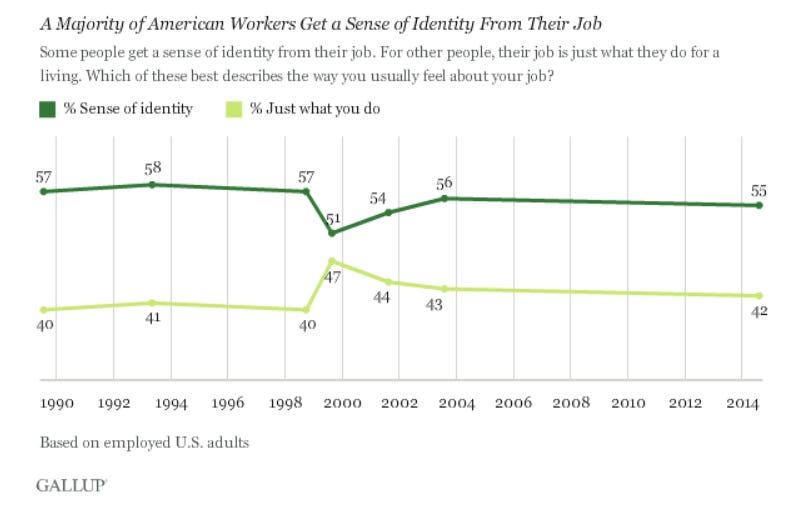
we have built entire identities on foundations that most of us secretly know are hollow. and those foundations are about to dissolve.
here is what i think preparation actually looks like. not a checklist. not a ten-step program. something more like a… reorientation.
become someone.
nietzsche wrote it as a commandment: “become who you are.” four words that contain an entire philosophy of selfhood. the implication is devastating. most of us haven’t yet — hell, i don’t even know who i am. so, so many masks to wear.
most of us are performing a role that was handed to us by economics, by parental expectation, by the crude machinery of institutional sorting. you studied this, you became that. you got hired here, you are this.
ask someone at a dinner party who they are. they will tell you what they do. i’m a project manager. i’m in consulting. i work in fintech. i’m a very successful crypto scammer. watch the silence where a self should be.
in a post-singularity world, that question will still be asked. the people who have an answer that doesn’t depend on a job title will be the ones who flourish.
cultivate genuine interests. not hobbies as lifestyle branding. interests.
there is a difference between collecting hobbies for your IG profile and actually caring about something. i mean the kind of interest that makes you lose track of time. the kind that pulls you into rabbit holes at 2am not because you’re avoiding sleep but because you need to know. astronomy. fermentation. the ottoman empire. the way mycelium networks communicate beneath forest floors (that’s truly fascinating, by the way). baroque architecture. whatever it is. the subject matters less than the act of caring about something for its own sake.
the hunter-gatherers of the kalahari, studied by anthropologist richard lee in the 1960s, worked roughly fifteen to twenty hours a week to meet their material needs. the rest was leisure. story. song. craft. conversation. games. cosmology. marshall sahlins called them the original affluent society. not because they were rich in our terms (their lives were definitely hard) but because they had solved the problem we pretend to have solved: how to live when survival doesn’t consume every waking hour.
we are about to re-enter that problem. and most of us are unprepared for it.
support my work with a one-time tip. thank you.
a 2019 study from cambridge confirmed what sahlins proposed decades earlier: hunter-gatherer communities in the philippines who turned to farming worked ten more hours per week and had significantly less leisure. the shift to agriculture didn’t liberate us. it employed us. and we have been employed, in increasingly abstract and meaningless bullshit ways, ever since.
the preparation is simple and radical: learn to be interested in the world again. not for career development. not for networking. for the bare, primal, animal pleasure of knowing things. it’s what we are as a species.
read. seriously, read.
montaigne retreated to his tower library in 1571 and spent the rest of his life reading, thinking, and writing essays about what it means to be human. he had no audience. no subscriber count. no content strategy. no substack even! he just wanted to understand himself, and he believed the best way to do that was through conversation with other minds across centuries.
that instinct is the most valuable thing you can develop right now.
read philosophy. read (science) fiction. read history. read actual science. read the stoics and the existentialists and the absurdists. read about camus imagining sisyphus happy. read thoreau walking through the woods trying to find the marrow of life:
read ursula k. le guin building anarchist utopias in space. read james suzman on why we work so much. read peter watts imagining post-human consciousness. just fucking read.
read things that are difficult. read things you disagree with. read things that make you feel stupid for the first thirty pages and then rearrange your entire understanding by page sixty.
the point is not to become an intellectual. the point is to build a mind that can sustain itself. that has depth. that can sit in a room without a screen and still be somewhere interesting.
build real relationships. not networks. relationships.
the harvard study of adult development, now running for over eighty years, has one finding that towers above all others: the quality of your relationships is the single greatest predictor of happiness and health. not wealth or status or achievement. just plain ‘ole relationships.
and yet. most adults in the modern world have outsourced their social lives to the workplace. your colleagues become your community by default, not by choice. the office provides structure, routine, daily human contact. it’s a daycare for adults, basically.
when that structure disappears, and it will, the people who have invested in friendships and community outside of work will have something to fall back on. the rest will have linkedin connections and a group chat that goes quiet the moment someone changes jobs.
i’m not fucking kidding. loneliness is already an epidemic. 20% of the world’s workers experience it daily. imagine what happens when the last pretense of forced togetherness evaporates.
build the friendships now. build the community now. join things. show up. be present with people in physical space, in real time, with no agenda other than pleasure.
(this does not necessarily, or to the full degree, apply to introverts (such as me)).
there is a historical parallel i want to tell you about.
in fifth-century athens, a class of citizens existed who did not work. the labor was done by others (slaves, to be honest about it). the free citizens had scholē. leisure. and from that leisure came philosophy, democracy, theatre, mathematics, rhetoric, sculpture, tzatziki. virtually everything we call western civilization emerged from a population that had time to think.
aristotle, who was one of them, argued that this was the entire point. that work existed only to create the conditions for leisure, and that leisure, properly used, was the highest form of human activity (as discussed in my previous essay).
we are approaching, for the first time in history, the possibility of athenian leisure without athenian slavery. AI replaces the slave class with something that doesn’t suffer, doesn’t bleed, doesn’t (yet) dream of freedom. the ethical problem that haunted every previous leisure society disappears.
but the psychological problem remains. what do you do with yourself when nobody is telling you what to do?
the athenians, naturally, had an education system designed for this. they called it paideia. the complete formation of a human being. you learned music, gymnastics, philosophy, rhetoric, poetry, mathematics, etc. you learned those things not to get hired but to become a person capable of participating fully in civilized life.
we have nothing equivalent. our education system is a pipeline into employment. it produces workers, not humans. and the workers it produces are increasingly irrelevant.
develop taste.
this sounds frivolous. i assure you it is not.
by taste i mean the capacity to encounter art, music, food, architecture, landscape, conversation, and have a response. to know what moves you and why. to have opinions that are genuinely yours, formed through exposure and reflection, not borrowed from algorithms.
alexander von humboldt, born into wealth in 1769, crossed the amazon, climbed volcanoes, measured magnetic fields, and essentially invented the modern concept of ecology. he was driven by an insatiable taste for the world. an aesthetic and intellectual appetite that could not be satisfied by comfort alone.
that appetite is what the singularity will reward. the capacity to be moved. to be curious. to want more from a tuesday afternoon than content consumption and the algorithmic drip of someone else’s curated life.
go to a gallery. listen to an album from start to finish (in order!). cook something complex. watch a film from a country you’ve never visited. read a poem slowly enough to feel it. these are not luxuries. they are training. they are the reps you need to build a self that can survive abundance.
figure out what you’d do for free.
this is the question that separates the prepared from the panicked.
if money were irrelevant. if survival were guaranteed. if every morning you woke up with nothing required of you. what would you do?
most people cannot answer this. not because they lack imagination but because the question has been made irrelevant by an economy that demands every waking hour be monetized. the very concept of doing something for free has been pathologized. if you’re not earning, you’re wasting. if you’re not productive, you’re failing.
bertrand russell mentioned this in 1932. in “in praise of idleness” he argued that the modern cult of work was a moral fraud, that most labor served no purpose beyond keeping the population too busy to think, and that a sane civilization would give people far more free time and trust them to use it well.
the singularity is about to prove him right.
start now. start finding the things that light you up for reasons that have nothing to do with money or status or career progression. woodworking. writing. long walks. languages. volunteer work. the music instrument you never had time to learn. the garden you never planted. the conversations you never had.
a brief word about money.
yes. if you believe, as i do, that artificial intelligence represents the most significant technological shift since the industrial revolution, then it is rational to position yourself to benefit from it financially. own a piece of the future. index funds with heavy AI exposure, direct investments in companies building the infrastructure of what comes next. i am not a financial advisor and this is not financial advice. but willful ignorance about the economic implications of the singularity is not a virtue. it’s a choice to let others capture the value of the transition while you watch.
that said. money is the least interesting form of preparation. and in a post-scarcity world, it may be the least relevant.
what nobody is saying yet:
the singularity will not just eliminate jobs. it will eliminate the excuse.
for centuries, most humans have been able to avoid the deepest questions about themselves by pointing to economic necessity. i would write that novel, but i have to work. i would learn piano, but i have no time. i would be a better parent, friend, thinker, lover, but the system won’t let me.
when the system stops demanding, those excuses evaporate. and you are left standing in a field with nothing but yourself and the terrifying, beautiful question: who are you, actually?
seneca again: “of all people only those are at leisure who make time for philosophy, only those are really alive.”
he didn’t mean academic philosophy. he meant the examined life. the deliberate life. the life that has been thought about, chosen, shaped by something other than the momentum of external demands.
you can start that examination now. you don’t need the singularity’s permission. you don’t need post-scarcity or universal basic income or the collapse of the office economy. you just need to decide, today, that the construction of a meaningful self is not something you’ll get around to after retirement.
lastly, a japanese concept called ikigai. it is often reduced to a venn diagram of what you love, what you’re good at, what the world needs, and what you can be paid for. this is a corporate bastardization of something far more profound. in its original meaning, ikigai is simply the reason you get out of bed. the thing that makes monday morning not a feast of dread.
in the old world, that reason was usually economic. you got out of bed because you had to.
in the new world, you will get out of bed because you want to.
building that want, right now, while the old structures still stand, is the most important preparation you can do. more important than any financial strategy. more important than any career pivot. more important than learning to prompt an AI.
learn to want something. learn to love something. learn to be something.
the sun is rising. a new one. strange and warm and full of light that we haven’t learned to see by yet.
the frost is still on the ground. the air still bites.
but the birds have already changed their song.
— Antonio Aestero
support my work
the best way to support my work is with a monthly subscription on patreon or here on substack:
but you can also support my work with a one-time tip. no commitments there. i like coffee. also, check out my presence on x where i share more opinions.
thank you.
Reading your piece makes me wonder how well We are set up to engage in leisure sustainably. Because leisure is enjoyable in solitude yes, and also with others. What forms of leisure do you wish you had access to?
Very nice! And very timely as I consider leaving the corporate world for good.
I’ve got a massive list of things to read already, but you’ve made me curious about what’s on yours. And what’s essential reading?