
that 6am feeling — living at the end & beginning of everything
you already know something enormous is happening. you went to work anyway.

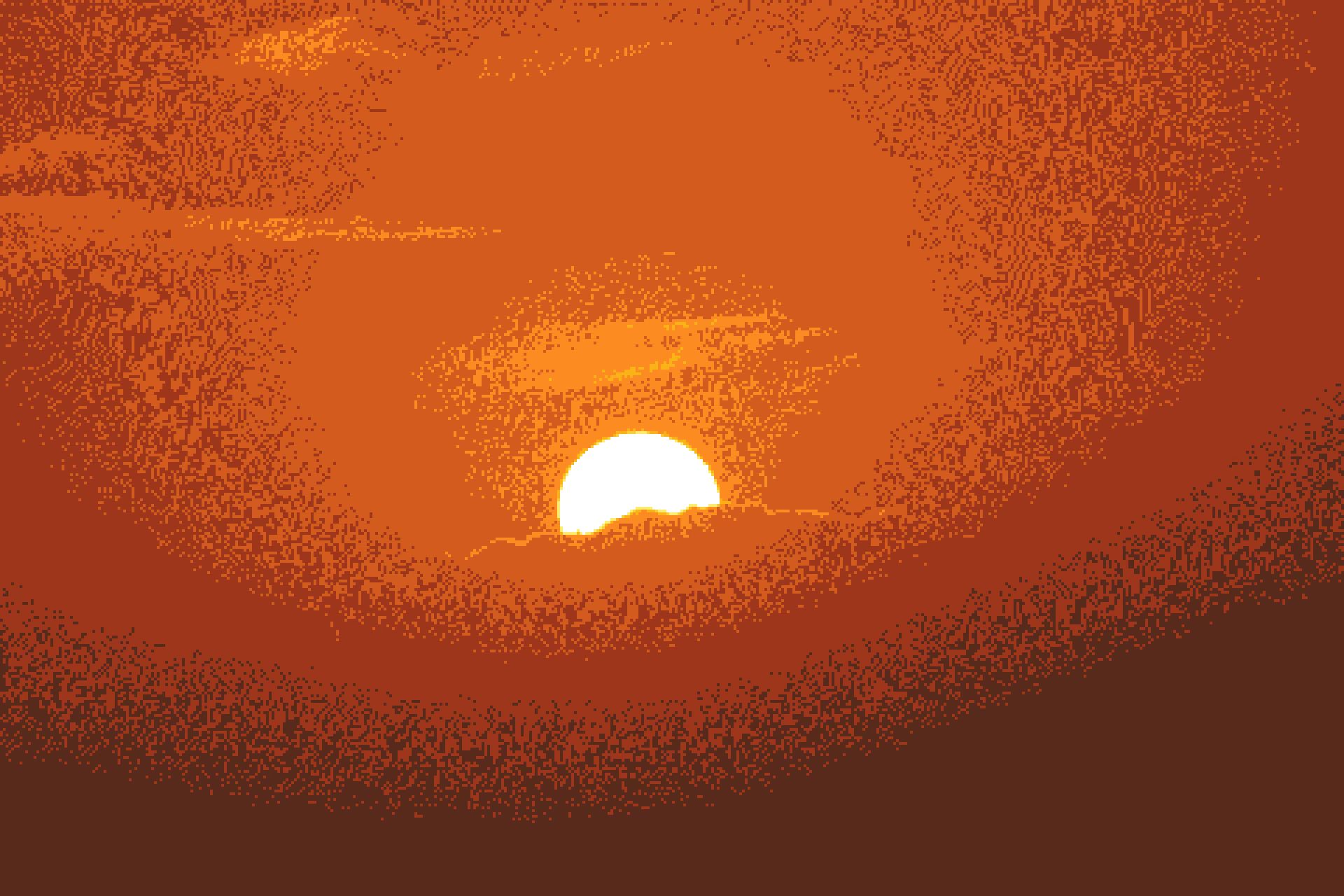
there is a feeling you get at 6am when the alarm goes off and the room is still dark and for a second you don’t know where you are. not confused. suspended. the dream hasn’t fully released you. the day hasn’t fully claimed you. you exist in this gossamer membrane between two realities, belonging to neither.
that second. that exact second. stretched across years.
that is what it feels like to be alive right now.
you know. that’s the strangest part. you already fucking know.
you’ve read the headlines. you’ve watched the demos. you’ve seen the graphs go vertical and felt that particular chill. not fear exactly, something more like recognition. the shape of a pattern completing itself. you’ve sat at your desk on a wednesday afternoon and thought, with total clarity: none of this will exist in ten years.
and then you finished the spreadsheet.
and then you joined the 3pm call.
and then you drove home, cooked dinner, kissed your kids (if you got them), set the alarm for 6am again — as if the world you’re preparing for is the same one you’ll wake into. knowing, somewhere beneath the routine (beneath the pavement, even), that it isn’t. that the ground has already shifted. that you’re rehearsing for a play that’s been quietly cancelled.
this is the condition i want to name. the specific, surreal, psychic texture of living in 2026.
the dream before waking. liminal. fantastic.
antonio gramsci, writing from a fascist prison cell in 1930, described the period between a dying order and one not yet born. he called it the interregnum. the crisis consists precisely in the fact that the old is dying and the new cannot be born.in this gap, he wrote, a great variety of morbid symptoms appear. slavoj žižek later rendered the line more poetically: now is the time of monsters.
gramsci was talking about politics. about the collapse of liberal democracy into fascism. but his observation has never been more literally true than it is right now — in a way he could not have fathomed.
the old world, the one organized around human labor, human cognition, human scarcity as the operating system of everything, is dying. you can feel it in the strange hollowness of job listings that read like they were written by a machine for a machine. in the quarterly earnings calls where CEOs mention efficiency gains with a particular softness, like doctors delivering a prognosis. in the way your company keeps restructuring. not toward anything, just away from what it was.
the new world, the one built on abundant intelligence, on machines that think and create and solve faster than any human who has ever lived, struggles to be born. it flickers. you see it in flashes. the AI that writes better code than your engineering team. the conversation with a chatbot that, for thirty seconds, felt more honest than anything you heard that week. the paper that drops on arxiv before lunch and renders an entire discipline slightly obsolete by dinner.
and you. you live in the gap.
good luck, mate.
support my work with a one-time tip. it helps. thank you.
there is a word from anthropology that describes exactly where we are. victor turner, studying rites of passage in zambian communities in the 1960s, identified a phase he called liminality — from the latin limen, meaning threshold (IN LIMINE, yes). the middle stage of a ritual. you have left the old identity. you have not received the new one. you are in-between, somewhere in the backrooms. neither here nor there.
turner noticed something unsettling about liminal people: they become invisible to the normal social structure. the rules stop applying. the old categories dissolve. there is a vertigo to it; a disorientation that can feel like madness or like freedom, depending on whether you resist it or lean in.
that is us. right now. an entire civilization in the liminal phase. we have left the old world. the one where human intelligence was the ceiling, where labor was the price of existence, where scarcity organized everything from cities to families to the arc of a single life. we have not entered the new one. we are in the passage. the hallway between rooms. The house of leaves. searching.
nobody is performing the ritual. there is no elder guiding us through the threshold. no ceremony marking the transition. just this ambient, low-frequency hum of something is happening, something enormous, and we don’t have a framework for it yet. just the alarm at 6am and the stupid spreadsheet and the useless 3pm call and the slow-building suspicion that all of it — every meeting, every email, every performance review — is scenery in a play the audience has already left. performance for performance’s sake.
let’s try to describe what this actually feels like. not theoretically. phenomenologically. the texture of the days i live, you live.
well, it feels like scrolling past a headline that says AI has matched expert-level reasoning on graduate-level problems and feeling nothing. not because it isn’t extraordinary (it’s one of the most significant developments in intellectual history) but because extraordinariness has become ambient. the miraculous is now tuesday. your brain has developed a callus.
it feels like explaining your job to someone and hearing, mid-sentence, how absurd it sounds. not the work itself, necessarily. the whole architecture around it. the standups. the syncs. the performance reviews where someone who has no idea what you do assigns a number to how well you did it. the entire apparatus of corporate productivity, humming along like a church organ in a building where nobody believes in god anymore.
i do digital marketing, for god’s sake.
it feels like planning a future you don’t believe in. saving for retirement in a currency that might not matter. building a career in a profession that might not exist. choosing a university for your kid as if the map of knowledge isn’t being redrawn every six months.
it feels like grief, except nobody died. something is dying though — a whole way of being human, a whole operating system for how we spend our only lives — but slowly enough that there’s no funeral. no marker. no moment where someone stands at a podium and says the era of human labor is over, please collect your things. just this ambient wrongness. this sense that the script you were handed at birth is being rewritten in real time and nobody told the actors.
currently, i’m applying to jobs. yes, you heard that right. i perform for companies that perform in return. i’m trying to switch from marketing to a role in IT. yes, you heard that right. i’m the living embodiment of someone in a suit stumbling through the backrooms without direction, without compass, because it’s the only thing he can do. fully knowing that all of it is a rather useless endeavour. but i’m austrian and things here move slowly. so i move slowly, too. for the better wage, you know.
it all feels like déjà vu to me, except backwards. you recognize the future. you’ve seen it coming for years. you just can’t get the present to acknowledge it. you pretend it’s still far off even though claude cowork can automate my whole current role, and do it better.
søren kierkegaard’s angst. not anxiety about something specific (that’s fear, and fear has an object). angst is anxiety about nothing. about freedom itself. about the yawning openness of possibility when every structure you relied on to make decisions for you starts to dissolve.
he wrote about this in 1844. he described it as dizziness. you stand at the edge of your own freedom and look down and the vertigo isn’t from the height. no, it’s from realizing that nothing is stopping you from jumping. that the railing was always imaginary.
we are a civilization standing at kierkegaard’s edge. the structures that told us who to be — your career, your title, your economic function, your place in the hierarchy of productive people — are dissolving. not someday. now. companies planning AI-related workforce reductions are not a forecast. they’re a fact. they happen all the time. still masked by other macro-economic and political factors, but definitely there, out in the open. accelerating.
and the vertigo isn’t abstract. it’s the 6am alarm. it’s the unanswered question in every quiet room: if not this, then what? if not this version of me, then who? some guidance for when everything fails:

yet here’s what i keep coming back to. here’s the thing that pulls me out of the vertigo every time.
this is the most interesting moment any human being has ever been alive for.
i mean that with total precision. not the most comfortable. not the safest. not the most fun. the most interesting. the most philosophically dense. the most charged with possibility and consequence and sheer, overwhelming newness.
every person who ever lived, every single one, would trade places with you. the stoics who wrote about the good life but spent their years under emperors who could murder them on a whim. the renaissance painters who imagined futures they couldn’t reach. the enlightenment philosophers who dreamed of universal knowledge but died before electricity. your grandparents who worked themselves into dust so you could have choices they couldn’t imagine.
all of them would want to be here. at the threshold. in the dream before waking.
not because the future is guaranteed to be good. but because this is when the question gets answered. the oldest question. the one humans have been asking since we first looked up and realized the stars were far away and we were very small indeed and time was short: what are we becoming?
every generation before us lived and died inside the question. we might be the ones who hear the answer.
there is an interesting concept in tibetan buddhism called the bardo — a transitional state between death and rebirth. the bardo is not peaceful. it is vivid, disorienting, full of projections and illusions. the mind, stripped of its familiar body and context, generates phantoms. beautiful ones and terrifying ones. and the entire challenge is to recognize them as projections. to not be swept away by the hallucinations of the in-between.
that’s 2026. the phantoms are everywhere. the doomer projections: civilization collapses, AI enslaves us, the permanent underclass forms and the gates close forever. the utopian projections: post-scarcity paradise, human flourishing, star trek by thursday. the hustle projections: buy nvidia, learn to prompt, position yourself on the right side of the divide before it’s too late.
all phantoms. not because they’re entirely wrong (each contains a fragment of something real) but because they are the mind’s attempt to resolve the ambiguity of the bardo. to collapse the liminal space into a story with a known ending. and the bardo resists. the threshold resists. the dream before waking resists every attempt to skip ahead to the morning.
the actual experience, the one that’s true, the one that doesn’t fit any narrative, is simpler and stranger than all of it. it’s the 6am alarm. it’s the dark room. it’s the one second of suspension where you don’t know which world you belong to.
stay there, perhaps.
i don’t have a prescription. i think my last essay was a mistake. not because the advice was wrong necessarily but because advice isn’t what this moment calls for. what this moment calls for is attention. the rarest, most radical thing you can offer the present tense.
because you won’t get this again. once the new world arrives, whatever it is, however strange, however beautiful or terrifying or both, the threshold disappears. you’ll be in it, the way you’re in any world: swimming, adapting, forgetting there was ever a before. the liminal moment will close. this strange, vertiginous, heartbreaking, electric time will become history. a paragraph in someone’s textbook. the early twenty-first century, a period of unprecedented transformation...
we won’t be a paragraph. we’re the ones who were actually here. actually feeling it. actually awake at 6am in the dark, suspended between two realities, belonging fully to neither, alive in the most interesting second in the history of the species.
the dream is ending. not with a crash. with a brightening.
pay attention. it’s beautiful.
it’s terrifying.
— Antonio Aestero
support my work
the best way to support my work is with a monthly subscription on patreon or here on substack:
but you can also support my work with a one-time tip. no commitments there. i like coffee. also, check out my presence on x where i share more opinions.
thank you.
you've described just what I've been feeling...
You’ve plucked the string that resonates across realities. I read your post, nodding all the while, watching the gleam of something on the horizon that has been in my awareness longer than I can account for it.
I don’t know when my expectation started to infiltrate my experience with actual hints. I recall being roughly 8 and awakening to the realization that we would be witness to the end of this. Not in a frightening way, but simply a quiet certitude that this generation was going to experience a transition that would spell a closure on the string of history we regard as our shared narrative.
That sense has never gone away. It’s at times felt alienating going through this life, being able to feel in my gut the futility of following the ordained late 20th century path traced for all of us. It hasn’t been easy with intuition leading me in illogical directions while my conditioned mind warned that my intuitions were going to lead to nothing but pain later. My conditioned mind still insists on my insanity, despite being able to see for itself the outlines of what my intuition knew all along.
We truly are blessed to be here, now. Not because it’s easy… but because we’re finally at the inflection point that resolves thousands of years of questions.
I almost didn’t post this. Then I read a little further in the comments and realized my perspective was not as universal as I thought. So I decided to post after all. Because if there’s anything I’ve understood, it’s that those of us who’ve been expecting this have the responsibility to help others grasp where we are, how to navigate it and integrate what will be catastrophically disorienting for many.
Thanks for sharing your experience with this. Reading your description has helped me name some of the things I hadn’t understood yet. It’s deepened by ability to express what I’ve intuited for decades. I hope as we wade into this transitional space, that more of us will appear - as much to guide and stabilize each other - as to shepherd those who we’re tasked with helping.