
the oldest hunger — meaning, machines, and empty cradles
we built a civilization that produces everything except a reason to continue.

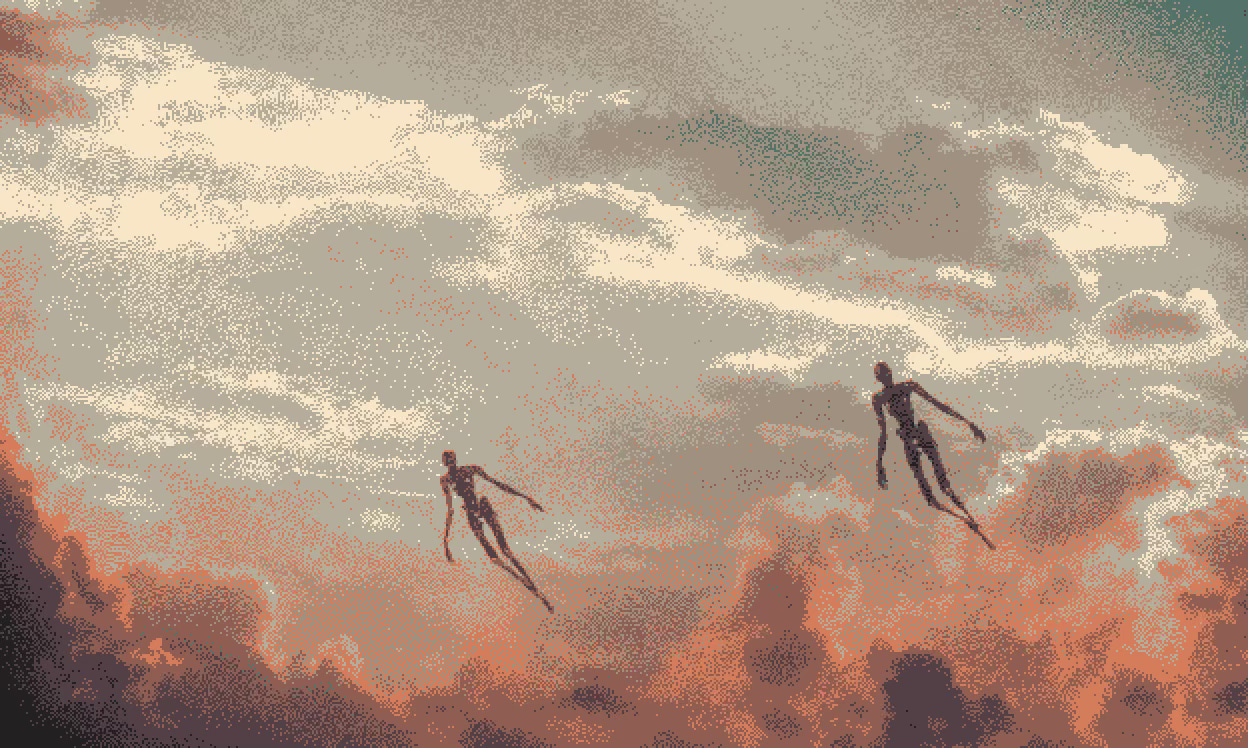
AI is a mirror. we don’t like what we see.
prophecy business
the conversation around AI sounds like fucking church. like child mini-me you’re dragged into it against your will.
the american kind. the tent revival, the prophecy, the screaming, the altar call. on one side, the evangelists: singularity by thursday, post-scarcity by the weekend, humanity 2.0 then 3.0 then silico-cloud hive loading, and why the hell not? on the other, the doomsayers: civilization collapse, the permanent underclass, skynet with better branding, everything bad. both speaking with the certainty of the converted. both with their scripture, their priesthood, their excommunication rituals for anyone who refuses to pick a side.
i’ve been somewhat guilty of the first camp, some of you will argue. IN LIMINE itself could read like a revival tract for the techno-optimist crowd. guilty as charged, partially. (also, you’re wrong.) here’s what both sides are missing, and what a certain breed of conservative essayist almost gets right before drowning insight in theology:
the hunger exists. the prophecy is false.
people aren’t losing their minds over AI because of AI. they’re losing their minds because AI has ripped the bandage off something that was festering. a wound older than the transformer architecture. older than silicon valley. older, perhaps, than capitalism itself. (no, that can’t be right. capitalism was always there, older than time itself. history ended a long time ago. whatever.)
yes! we built a civilization that is extraordinarily good at producing things and extraordinarily bad at producing meaning.
and the machine, bless its probabilistic metal heart, has made that impossible to ignore.
the void was here first
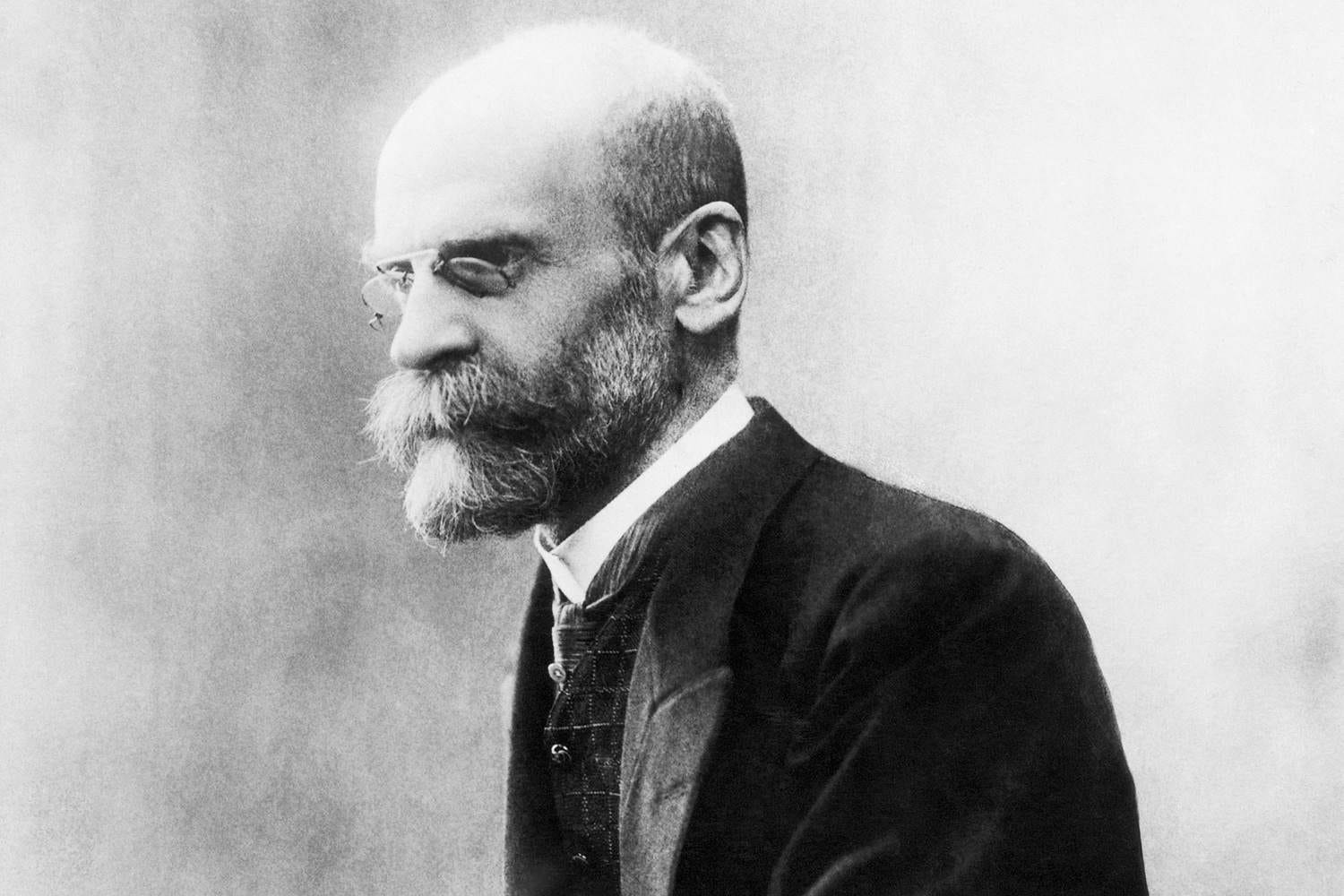
émile durkheim coined a word for it in 1897: anomie. the condition of a society that has dissolved its shared moral framework without replacing it with anything coherent. not chaos. even worse.
purposelessness with a salary.
he was describing the aftermath of industrialization. the old village, the old church, the old rhythms of planting and harvest and feast and maidens one wrote embarrassing songs for — all swept away by factories and cities and the Orwellian logic of production. what replaced it wasn’t freedom, of course (do you feel free in any meaningful way?). it was vacuum dressed up as progress. and in that vacuum, durkheim spitted and rapped, people didn’t flourish. no, no, no, they unraveled. suicide rates climbed not during poverty or war but during disruption. when olden structures dissolved and emptiness rose to take their place.
sound familiar? hmm? yes?
yes it does.
we have been living in durkheim’s anomie for over a century. we just didn’t notice because we were busy busy busy little bees. the job filled the hole. the career filled the hole. the mortgage, the performance review, the linkedin profile. spackle over a black hole. the big kind. those primordial ones from the beginning of the universe.
the spackle is dissolving, for God’s sake!
AI doesn’t create the emptiness. it reveals it. when a machine can write your stupid little emails, generate your reports, produce your marketing copy faster and better than you can what’s left is not the work. the work was already hollow. what’s left is the question underneath. the one you’ve been too busy to ask since you were twenty-two and took that first job because you were under the influence.
what is any of this actually for?
i sit in my apartment, applying for jobs. i write cover letters for positions that might not exist in five years. i tailor CVs for hiring managers whose own roles are rightfully being automated. i do it anyway. the rent doesn’t care about philosophical awakenings.
absurd.
support my work with a one-time tip. it helps. thank you.
inner foreman
the pessimists understand something the optimists often don’t: AI is a force multiplier. it amplifies whatever is already there.
for the person with genuine skill, deep curiosity, real craft — rocket fuel, baby! for the person hollowed out, running on fumes of performed competence — the hole is over there, buddy. more efficiency applied to a life that was already efficient at avoiding itself.
byung-chul han, the korean-german philosopher, calls our era the burnout society. not because we work too hard. because we have internalized the demand to perform so completely that we can no longer distinguish between living and producing. we have become what he calls achievement-subjects: people who exploit themselves more efficiently than any boss ever could.
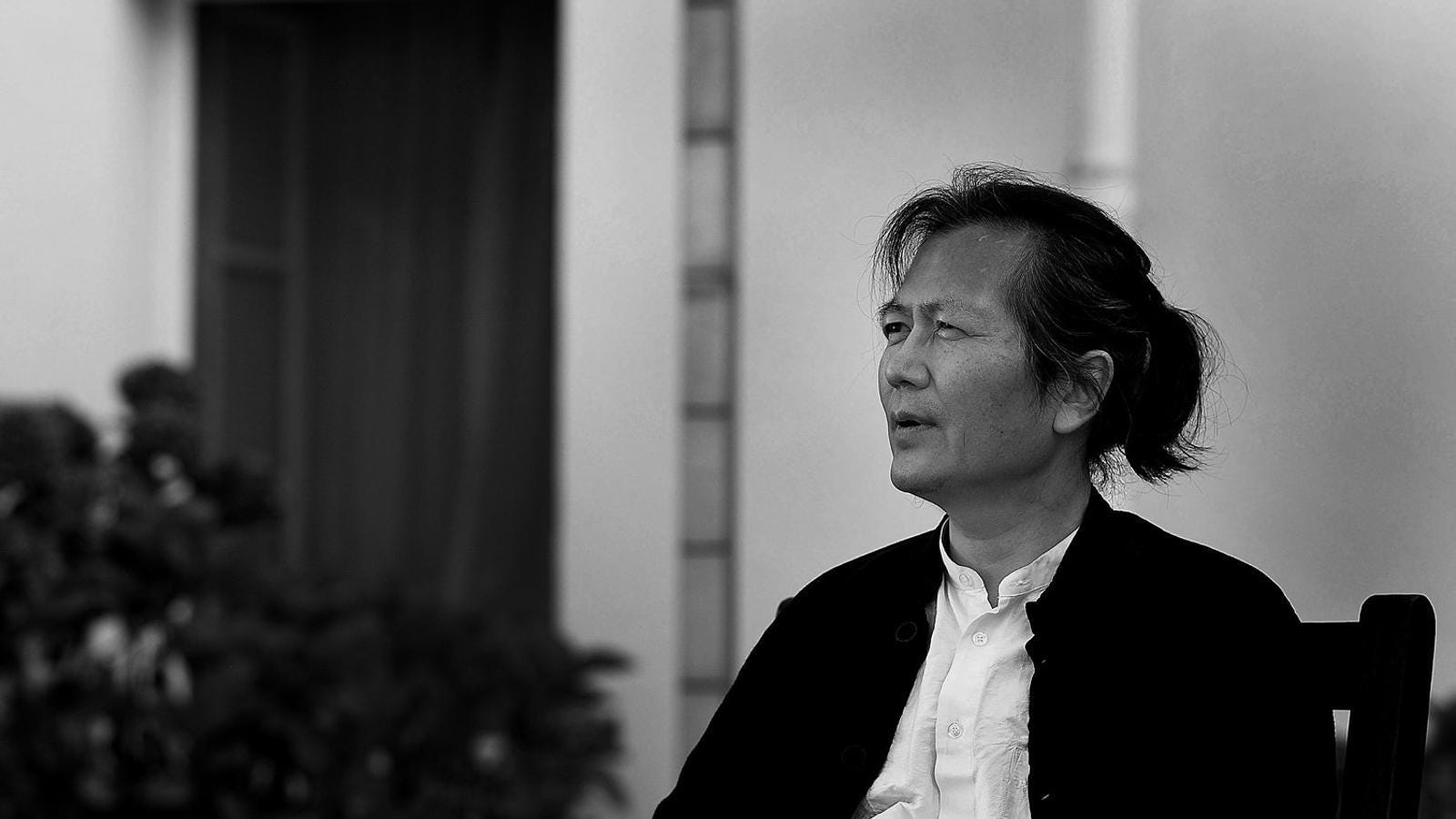
the exploiter is simultaneously the exploited. master and slave. the foreman moved inside.
the factory owner at least had the decency to be a person you could hate. the achievement-subject runs a sweatshop of one, and calls it self-improvement. calls it hustle. calls it passion. posts about it on linkedin at 6am with a sunrise emoji and a note about the grind.
AI is laying off the inner foreman. the panic you feel isn’t about unemployment.
it’s about what you’ll find once the foreman’s been murdered.
empty cradles
i think about children.
i don’t have any yet. i’m in my thirties, living in a country where bureaucracy moves at geological speed and the cultural expectation is: career first, stability first, then maybe family, if the spreadsheet allows it. watch the demographic data the way you watch a slow-motion avalanche: fertility rates below replacement in virtually every developed nation. south korea at the lowest ever recorded for any country anywhere. here in austria we just reached a record low of 1.29 children per woman. OECD average halved since 1960, from 3.3 to 1.5 children per woman. the species that colonized every continent, survived ice ages, hunted mammoths, built pyramids and particle accelerators politely declining to continue.
the standard explanation is economic. children are expensive. housing is insane. nobody has time.
sure, sure, but that’s not it, man. that’s not all of it.
our grandparents were poorer and had more kids. our great-grandparents were much poorer and had even more. the correlation between wealth and fertility runs exactly backwards. it’s not that we can’t afford children. it’s that we can’t afford the meaning children require.
because having a child is an act of insane, beautiful faith. you are declaring — with your body and your soul and your years and your sleep and your money — that the future is worth continuing. the human story deserves another chapter. something matters beyond your own brief flicker.
and we don’t believe that. not enough of us. not viscerally. because what exactly are we continuing? the commute? the open-plan office? the quarterly review? the grind? this?
viktor frankl, writing from auschwitz (man, what a context switch. apologies for that.), observed that the prisoners who survived were not necessarily the strongest. they were the ones who had something to live for. a child waiting. a book unfinished. a love not yet fully spoken. meaning, he said, is not a luxury. it is the thing that keeps the organism alive when everything else is stripped away and burned.

we have not lost meaning because the universe is empty. we have lost meaning because we built an economic system that systematically strips it from everyday life. and then we wonder why nobody wants to bring children into it.
south korea has spent over $270 billion trying to incentivize childbirth. baby bonuses. tax breaks. subsidized childcare. the rate keeps falling. you cannot subsidize purpose. you cannot policy-hack your way to a population that wants to exist.
meaning emerges when people have the space and presence to discover what matters to them. and we have not given them that.
until now.
nobody-owns-this time
imagine.
the economic boot lifts. not all at once. i’m not naive. i wrote a whole essay about the terrifying intermediate:

but gradually, then suddenly. the bullshit jobs dissolve. the performed productivity ends. and in its place: time. actual, uncolonized, nobody-owns-this time.
what happens to families?
the grandmother embedded in a household that has room for her stories. her irritating opinions about how you cook pasta. children surrounded by adults who aren’t checking slack during dinner. parents who are present. not the instagram version of present, not quality-time-as-guilt-management, but actually, boringly, beautifully there. tuesday afternoon there. wednesday morning there.
what happens to neighborhoods?
people in them. during the day. knowing each other’s names, perhaps. the way they did before the factory and the office emptied every home between 8 and 6.
what happens to birth rates?
it changes. not because of subsidies but because the calculus of parenthood shifts from sacrifice to invitation. because a child stops being a career-ending catastrophe and becomes what it always should have been: the most interesting thing you could possibly do with your life.
attention is all you need
there’s a particular kind of thinker — educated, eloquent, usually conservative — who looks at the meaning crisis and prescribes church. come back to the pews. come back to the liturgy. come back to the god who will fill the void.
i understand the impulse. the church provided community, ritual, shared narrative, intergenerational continuity. all the things we’re starving for. but you can’t un-know things. you can’t manufacture belief because the alternative is uncomfortable. and faith wielded as a solution to existential dread isn’t faith.
simone weil, one of the most deeply spiritual thinkers of the twentieth century (a woman who deliberately never joined any church despite spending her entire adult life with the sacred), wrote in a 1942 letter that attention is the rarest and purest form of generosity.

she didn’t mean focus. she didn’t mean concentration. she definitely didn’t mean mindfulness-as-productivity-hack. she meant the capacity to be fully present to what is. to another person’s face. to beauty that serves no function. to suffering you can’t fix. to the irreducible mystery of being conscious in a universe that didn’t have to include consciousness at all. just exist, bro.
that is the closest thing i know to the sacred.
and you can’t get there while the inner foreman is screaming about deadlines. you can’t get there in the fifteen minutes between the standup and the sync. you can’t get there when every waking hour has to be about performance or being useful.
some intelligent people keep arguing that nothing big is happening. that AI is just another golden calf. that the real answers were given to us long ago (in scripture, in tradition, in the accumulated wisdom of the ages) and we simply refuse to receive them.
they’re half right. the answers were given to us long ago. but not by any single god or text. by the accumulated weight of human experience across every culture.
connection. presence. love. purpose beyond the self. finding answers to questions no one ever asked before.
like illustrated in this essay:

where these thinkers go wrong is the conclusion. they think the machine threatens these things. i think the machine is the first force in history powerful enough to give them back. not through techno-utopian fantasy. through the simple, brutal, liberating act of making the bullshit unnecessary. of ending the performance. clearing the stage so the actual play can begin.
what now?
spring doesn’t announce itself with a press release. it comes in the soil first. in the dark, where the frost is loosening its grip on roots you forgot were there.
the biggest thing happening right now is not AI.
the biggest thing is what AI forces us to see about what was already missing. and the even bigger thing, the thing that makes this moment different from every previous crisis of meaning, is that for the first time, we have the tools to get it back.
not through faith in silicon. not through faith in a god you have to squint to believe in. through the terrifying, simple act of stopping. looking around. asking.
the machine cannot answer for us. but it can, at last, give us the time to find out.
the hunger is ancient.
— Antonio Aestero
support my work
the best way to support my work is with a monthly subscription on patreon or here on substack:
but you can also support my work with a one-time tip. no commitments there. i like coffee. also, check out my presence on x where i share more opinions. on instagram and tiktok i just started sharing short snippets from my essays.
thank you.
Irrespective of whether I agree with everything or not, this article genuinely gives me a pinch of hope. I also found shades of Dostoevsky’s Notes from the Underground in the way you wrestle with the tension between material abundance and inner emptiness. Thank you for this piece!
Once again, exactly correct for the wrong reason.