
the last thing human hands will build
we shaped stone. stone shaped us. something else will do the shaping now.

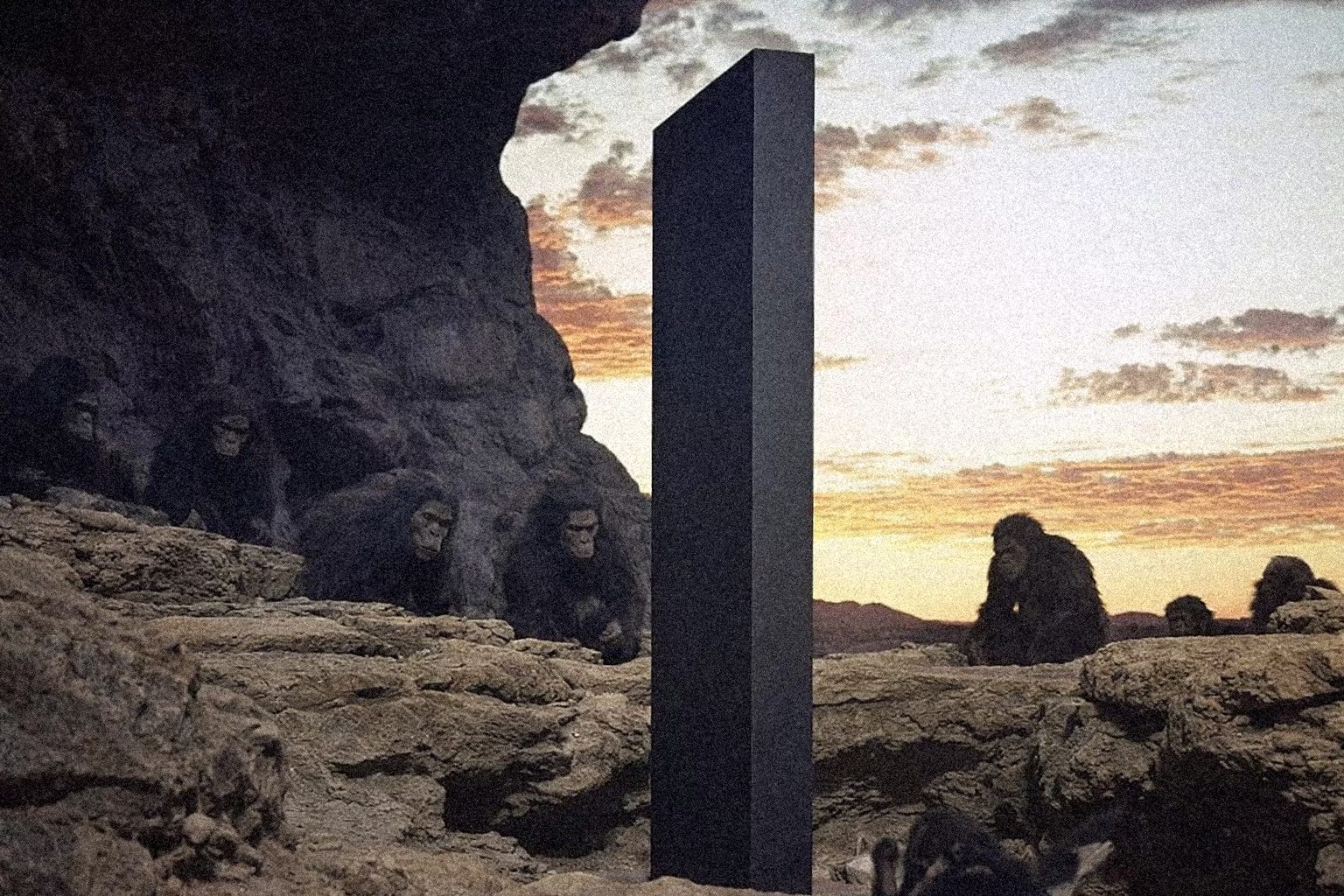
walk with me.
imagine a museum. not one that exists but one that should exist. the museum of tools. every object humanity has ever made to extend itself, laid out chronologically, room after room after room, three and a half million years of reaching.
you enter through a dark corridor. the air is cool. the first exhibit is behind glass, lit from below: a chunk of volcanic rock from lomekwi, kenya, edges chipped away by something that wasn’t yet human. 3.3 million years old. whoever made it: we don’t even know what species they were. not homo sapiens. something older, something with hands that ached for a sharper edge and a brain that figured out how to get one.
hold that image. something not quite us picking up a stone and thinking:
i can make this better.
that’s the whole story. that’s the entire museum in one gesture. everything that follows (the wheel, the printing press, the steam engine, the semiconductor, splitting the atom, the large language model, dyson spheres) is just that same reach, repeated and refined across an ocean of time.
what nobody tells you about romantic stories: they end.
something alien takes over.
heidegger had this idea. he called it zuhandenheit, which translates roughly as “readiness-to-hand.” the guy spent years thinking about hammers. what a weirdo. well, his insight was that when a tool works perfectly, it disappears. you don’t think about the hammer. you think about the nail. the tool becomes transparent, an extension of intention. it’s only when the hammer breaks that you suddenly see it as an object again.
this is maybe the most profound thing anyone has ever said about tools.
because what heidegger accidentally described is the entire arc of human technology. every tool we have ever built has been an attempt to disappear. to become so seamlessly integrated that the boundary between person and instrument dissolves. the stone blade. the pen. the bicycle. the smartphone. each one a little more invisible, a little more part of you.
and AI? AI is the tool that finally, fully disappears. not because it’s transparent (it’s no yet) but because it’s the first tool that can make other tools that aren’t just copies of existing ones. the first one that soon won’t need a human hand at all.
we built the thing that builds things. and now our hands are just… there. holding coffee. scrolling. fidgeting. occasionally masturbating.
the next room in the museum is enormous. this is the room of hands.
you need to understand: the human hand is not a given. it’s an argument. it’s 3.3 million years of biological reasoning about what a body should be shaped like when its primary survival strategy is making stuff.
our thumbs are proportionally longer than any other primate’s. our fingertips are broader, packed with nerve endings. the muscles in our palms are arranged for what biomechanists call “forceful precision grip” — the ability to hold a stone in one hand and strike it with another, hard, without shattering your own fingers. a 2024 study in the journal of human evolution found evidence that even australopithecus (pre-human hominins) had hands adapted for this kind of manipulation. we were toolmakers before we were human. the tools made us.
marx understood this, even if he got the economics wrong. in capital, he writes that the tool is the extension of the human body and the machine is the extension of the tool. but the part nobody quotes is the now-fact that eventually, the machine won’t need the body anymore. the worker becomes an appendage of the machine, rather than the other way around.
he was writing about factories. and he was describing the future.
support my work with a one-time tip. it helps. thank you.
the museum continues.
you walk through rooms of increasing complexity. bronze tools. iron tools. mechanical looms. the jacquard loom: the first programmable machine, controlled by punch cards, 1804. the room smells different now. oil and metal. the tools are getting louder, bigger. the hands holding them are getting smaller in relation.
hannah arendt made a distinction. in the human condition, she separates labor from work from action. labor is what the body does to survive: repetitive, cyclical, consumed immediately. work is what the hands do to build a durable world: the table, the house, the bridge. action is what humans do together: politics, speech, the creation of meaning.
her fear — and this was back in 1958, before computers could do anything except somehow calculate missile trajectories — was that modern society was collapsing work and action into labor. that everything was becoming process. maintenance. the endless cycle of producing and consuming with nothing durable left behind.
and she was right. most office work today is labor dressed up as work. it’s process. it’s maintenance of systems that maintain other systems. it’s bullshit all the way down, and the only reason it persisted this long is that humans were cheaper than the alternative.
the alternative has arrived.
now what? if the machines do the labor, and increasingly the work, then what’s left? arendt would say: action. the thing machines fundamentally cannot do. the creation of meaning between people. the public sphere. the space where we show up as who we are.
andy clark and david chalmers published a paper in 1998 called “the extended mind.” their argument: the mind doesn’t stop at the skull. when you use a notebook to remember things, the notebook is part of your cognitive system. when you use a calculator, the calculation is happening partly in your head and partly in the device. the boundary between self and tool is, philosophically, arbitrary.
this was controversial in 1998. it’s pretty obvious now. your phone is part of your mind. your search engine is part of your memory. your GPS is part of your spatial reasoning. we have been merging with our tools for decades.
but clark and chalmers were still thinking about tools that extend. tools that add capability. what happens when the tool doesn’t extend you but replaces you? when the cognitive system doesn’t need the biological component?
(this is not a hypothetical question.)
the answer, i think, is that the human part of the system has to find something else to be. something the tool cannot be. and here’s where i get optimistic, which, if you’ve read my earlier work, you know does not exactly come naturally to me.
the last room of the museum.
the lights are different here. warmer. golden.
the exhibits aren’t tools anymore. they’re things humans made for no functional reason. cave paintings. a flute carved from a vulture bone, 40,000 years old. a child’s clay figurine. a love letter. a cathedral. a poem.
these aren’t tools. these are what arendt would call action. these are the things humans made because they were alive and wanted other humans to know it. to feel it. to share the weird, unbearable, gorgeous experience of being a conscious creature in a universe that didn’t ask for consciousness and got it anyway.
no tool made these things necessary. no automation will make them unnecessary.
the hand that has nothing left to grip can still reach for another hand. can still press paint into stone. can still gesture toward something that has no name yet. the hand doesn’t stop being useful when it stops being productive. it stops being useful when it stops being expressive.
marshall mcluhan said every tool is an amputation. the wheel amputates the foot. the book amputates the memory. the phone amputates the voice’s need for proximity.
so what does AI amputate?
maybe: the need to be useful. the entire identity structure built around productivity and output and the idea that you are what you do for money.
good. burn it down. that identity was always a cage anyway. a very convincing cage, with some benefits and the illusion of purpose, but a cage.
on the other side is something terrifying and ancient and real. the question that humans asked before there were jobs, before there were tools, before there were even words for it.
what is this? what am i? what are we doing here?
the museum of tools ends where the museum of meaning begins. and we haven’t even started building that one yet.
— Antonio Aestero
support my work
the best way to support my work is with a monthly subscription on patreon or here on substack:
but you can also support my work with a one-time tip. no commitments there. i like coffee, a lot. also, follow me on x where i share more opinions.
thank you.
Very interesting, thanks for writing.
You might enjoy visiting la Musée des Arts et Metiers, in Paris! The collection exhibits human innovation largely in the form of tools and technology, though I believe it starts a little later on in the scheme of things.
<< Founded in 1794 by Henri Grégoire, the Conservatoire national des arts et métiers, "a store of new and useful inventions," is a museum of technological innovation. >>
https://en.wikipedia.org/wiki/Musée_des_Arts_et_Métiers